The manufacturing industry has long relied on physical prototyping and real-world testing as the ultimate validation step. But that paradigm is rapidly giving way to a new approach: simulation-first. By leveraging high-fidelity digital environments, companies can now train AI models, test production lines, and optimize processes before a single physical part is made. This article answers key questions about how OpenUSD, SimReady, and the NVIDIA Omniverse stack are enabling this transformation, with real-world results from ABB Robotics and JLR.
What is the simulation-first era in manufacturing?
The simulation-first era marks a fundamental shift from the traditional design-build-test cycle to a virtual-first workflow. Instead of treating physical testing as the only reliable validation method, manufacturers now use high-fidelity simulations to generate synthetic data, train AI models, and validate production systems entirely in digital environments. This approach reduces reliance on costly prototypes and accelerates time-to-market. With tools like OpenUSD and NVIDIA Omniverse, simulations can accurately replicate real-world physics and lighting, making them trustworthy for production-grade AI. The result: companies can detect and fix issues early, iterate faster, and achieve “right-first-time” manufacturing.
How does OpenUSD enable manufacturing simulation?
OpenUSD (Universal Scene Description) serves as the connective tissue that allows 3D assets to move seamlessly between different software tools. In manufacturing, models often lose physics properties, geometry, or metadata when transferred from CAD to simulation platforms. OpenUSD standardizes the representation of 3D scenes, ensuring that SimReady assets retain all necessary attributes—such as mass, friction, material properties, and collision shapes—across rendering, simulation, and AI training pipelines. This interoperability is critical because it eliminates the need for manual rebuilding and enables a unified digital thread from design to deployment. NVIDIA Omniverse builds on OpenUSD to provide a physics-accurate, photorealistic simulation layer where AI models can be trained and validated before being deployed on the factory floor.
What is SimReady and why does it matter?
SimReady is a content standard built on OpenUSD that defines what physically accurate 3D assets must contain to work reliably across different applications. Without a standard like SimReady, assets often require manual repair or re-creation when moved from a design tool to a simulation environment—wasting time and introducing errors. SimReady ensures that each asset includes accurate physics properties (mass, inertia, material friction), correct geometry with LODs (levels of detail), and clean metadata (part numbers, sensor parameters). This consistency is essential for training physical AI models, which rely on realistic simulation data to learn how to interact with real-world objects. Manufacturers adopting SimReady can dramatically reduce asset preparation time and increase simulation fidelity.
How is ABB Robotics using simulation to achieve 99% accuracy?
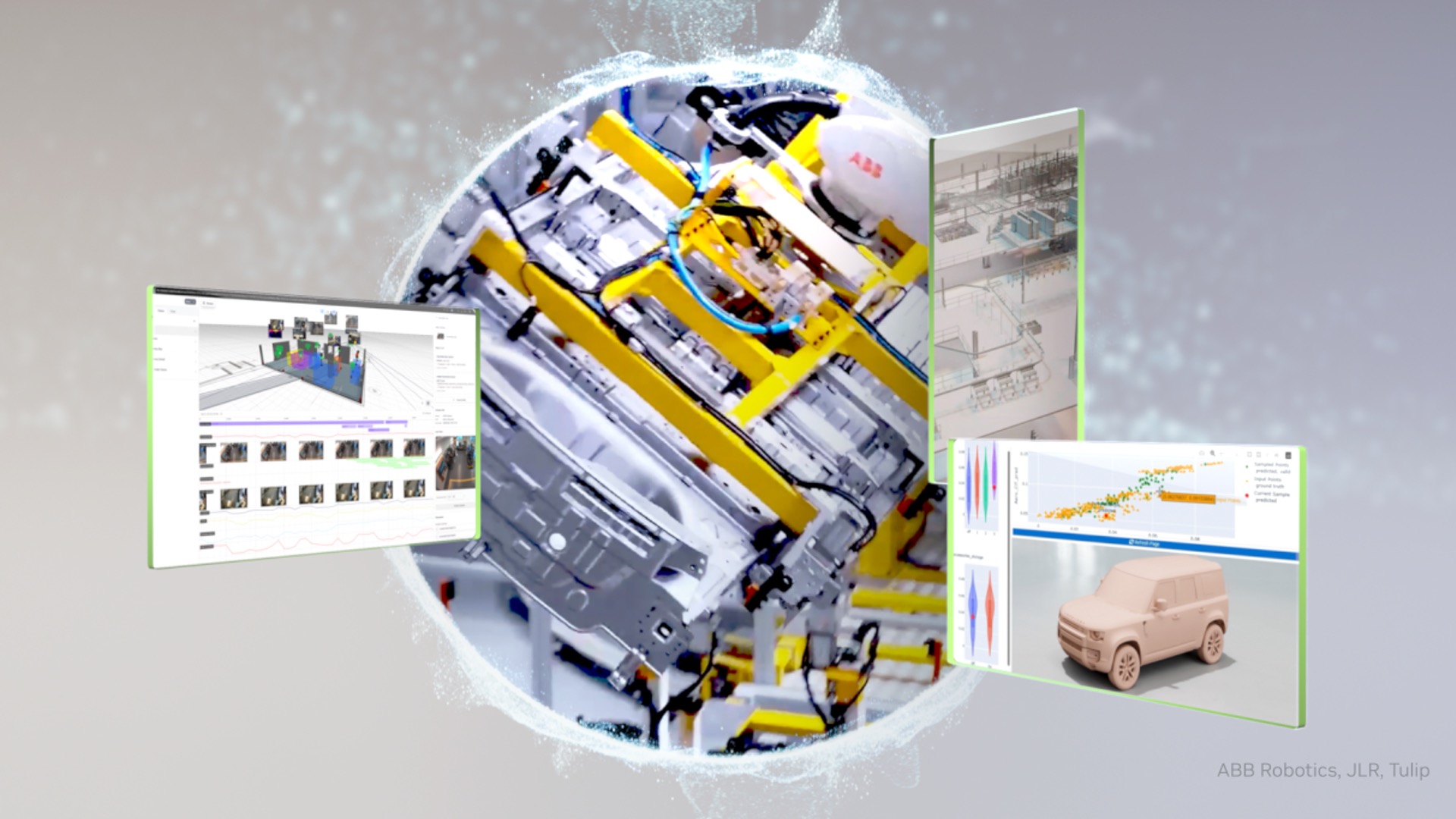
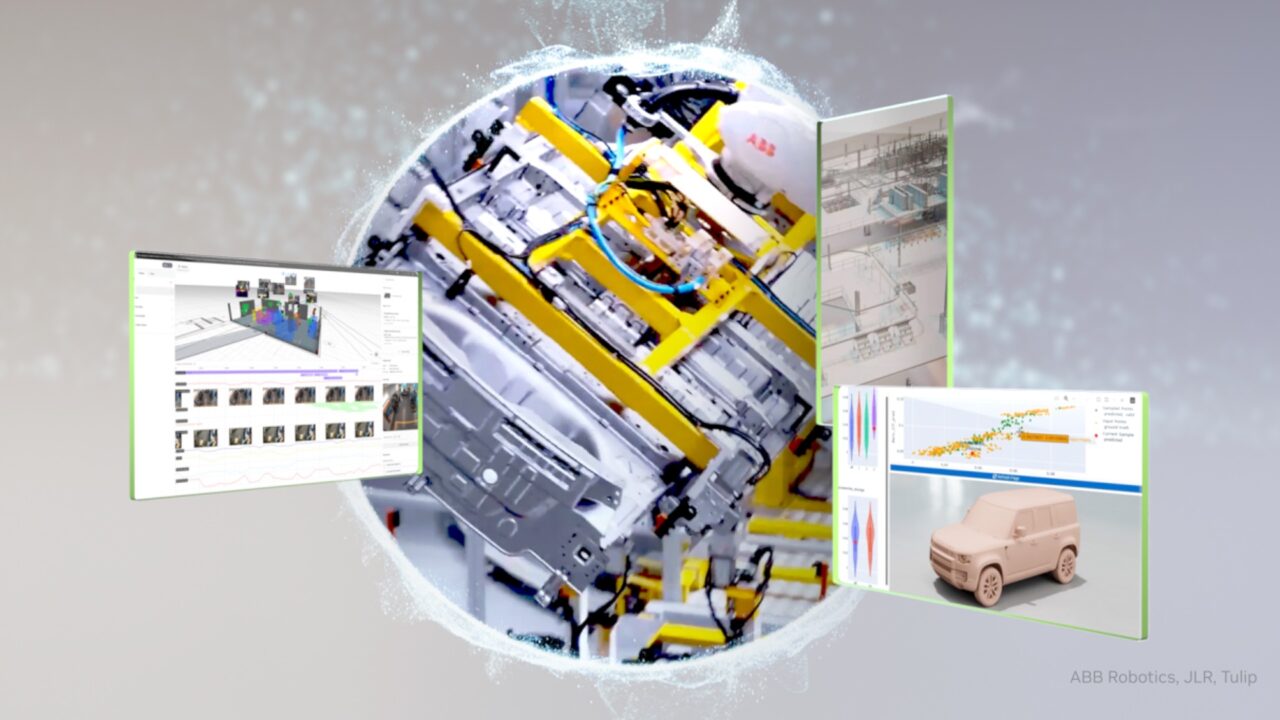
ABB Robotics integrated NVIDIA Omniverse libraries into its RobotStudio HyperReality platform, used by over 60,000 engineers. The platform represents robot stations as USD files running the same firmware as their physical counterparts. This enables ABB to train robots, test part tolerances, and validate AI models entirely in simulation before building a production line. By generating synthetic training variations—such as changing lighting, camera angles, or component geometry—ABB can cover scenarios that would be impractical to test manually. The result: 99% accuracy between simulated and real robot behavior. Downstream benefits include up to 50% fewer product introduction cycles, 80% faster commissioning, and 30-40% lower total equipment lifecycle costs. This real-world validation proves that simulation-first is not just theoretical—it delivers measurable impact.
How did JLR compress aerodynamic simulation from four hours to one minute?
JLR applied the simulation-first principle to vehicle aerodynamics. Engineers trained neural surrogate models on over 20,000 wind-tunnel-correlated computational fluid dynamics (CFD) simulations covering their vehicle portfolio. By using NVIDIA GPU-accelerated computing and Omniverse, they compressed what previously took four hours of CFD simulation into a single minute with the surrogate model. This dramatic speed-up allows JLR to explore far more design iterations in the same time frame. They now run 95% of their aero-thermal workloads on GPU-accelerated infrastructure, enabling faster, more efficient vehicle development. The shift from slow, batch-style simulations to real-time, interactive exploration is a key example of how simulation-first approaches are transforming automotive engineering.
What are the benefits of using synthetic data in manufacturing?
Synthetic data—generated from simulation rather than captured from the real world—offers several advantages in manufacturing. First, it can be produced at scale, covering edge cases and rare scenarios that would be dangerous or expensive to replicate physically (e.g., robot collisions, sensor failures). Second, it allows for controlled variation: lighting conditions, background clutter, object poses, and environmental effects can be systematically modified to make AI models more robust. Third, synthetic data accelerates the development of perception systems (like computer vision) and agentic workflows (autonomous robots) by providing perfectly labeled ground truth data without manual annotation. Companies like ABB and JLR demonstrate that combining synthetic data with high-fidelity simulation yields AI that performs as well as—or better than—models trained on real data alone.
What role does NVIDIA Omniverse play in physical AI?
NVIDIA Omniverse provides the physics-accurate, photorealistic simulation environment needed to train and validate physical AI models before deployment. It integrates with OpenUSD to create a digital twin of the factory floor, where robots, conveyor belts, sensors, and products interact with realistic physics. Omniverse also connects to AI training frameworks, allowing synthetic data generated in simulation to feed directly into neural networks. This seamless pipeline—from simulation to training to deployment—is what enables the simulation-first approach to work at scale. Manufacturers use Omniverse to run thousands of simulated scenarios in parallel, covering everything from robot motion planning to defect detection, all without disrupting live production. The stack also supports collaborative design reviews across teams in real time, further accelerating development.