Overview
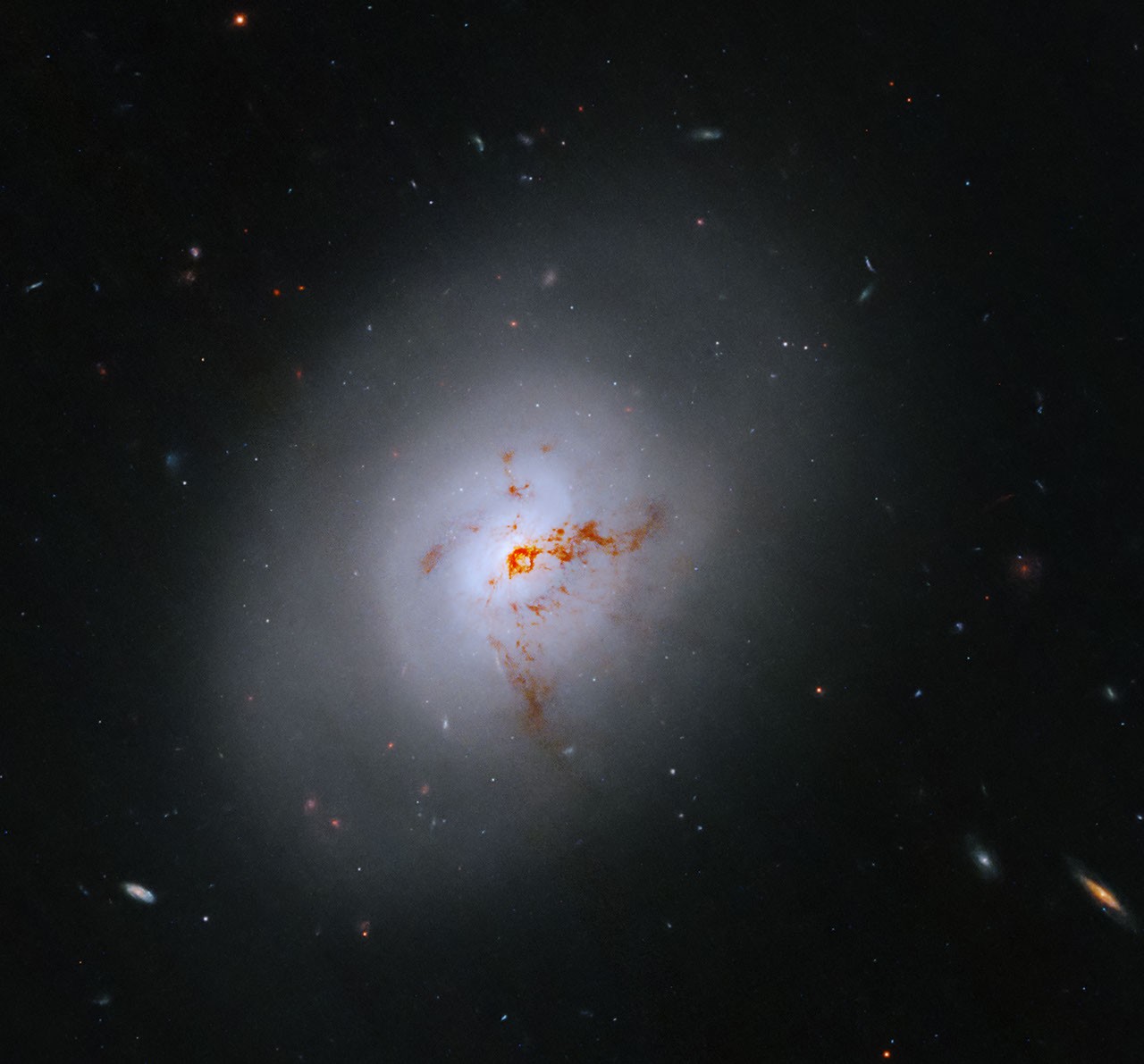
Galaxies come in many shapes and sizes, and their classification often tells a story of cosmic evolution. Among the most intriguing are lenticular galaxies—transitional objects that bridge the gap between spirals and ellipticals. In a recent observation, the NASA/ESA Hubble Space Telescope turned its gaze toward NGC 1266, a lenticular galaxy located about 100 million light-years away in the constellation Eridanus. This image reveals a bright central bulge and a flat disk hinting at spiral structure, but without the obvious spiral arms. More captivating is its classification as a post-starburst galaxy—a rare state where a galaxy has recently experienced a burst of star formation and is now settling into a quieter, elliptical-like phase.
This tutorial will guide you through the features of NGC 1266, explain the lenticular and post-starburst classifications, and explore what this galaxy tells us about galactic evolution. By the end, you'll be able to identify transitional galaxies and understand the processes driving their transformation.
Prerequisites
To get the most out of this guide, you should have:
- Basic knowledge of galaxy morphology – familiarity with spiral, elliptical, and irregular types.
- Understanding of star formation – what triggers star formation and how it is observed (e.g., H-alpha emission, ultraviolet light).
- Familiarity with Hubble Space Telescope – its imaging capabilities and role in extragalactic astronomy.
- Optional: Access to astronomical databases like the NASA/IPAC Extragalactic Database (NED) to explore NGC 1266 further.
Step-by-Step Instructions
Step 1: Identify the Lenticular Galaxy Features
Lenticular galaxies (classification S0) are lens-shaped. In Hubble's image of NGC 1266, note the following traits:
- Bright central bulge – a dense, spheroidal center dominated by old stars.
- Faint, flat disk – similar to spirals but lacking spiral arms.
- Dust lanes – reddish-brown clumps and filaments that partially obscure the galaxy's face.
- No prominent spiral arms – the disk appears smooth, though it may have subtle structure.
Compare this to a classic spiral (like the Milky Way) or an elliptical (like M87). Lenticulars fall in between—they have a disk and bulge like spirals but little gas and dust, and low star formation like ellipticals.
Step 2: Understand the Transitional Nature of Lenticulars
Astronomers consider lenticular galaxies as an evolutionary bridge. Evolution proceeds roughly:
- Spiral galaxies – rich in gas and dust, actively forming stars, with clear spiral arms.
- Lenticular galaxies – depleted gas, star formation slowing, arms faded or absent.
- Elliptical galaxies – mostly old stars, little dust, no disk structure.
NGC 1266's structure matches S0: it retains a disk (from its spiral past) but has lost its arms and most of its star-forming gas. The galaxy is halfway through this transformation.
Step 3: Recognize the Post-Starburst Characteristics
Post-starburst galaxies (also called E+A galaxies) have a unique spectral signature: strong Balmer absorption lines (indicating young stars) but weak or absent emission lines (indicating little ongoing star formation). NGC 1266 is a rare example—only about 1% of local galaxies are in this phase.
Key observable signs:
- Young stellar population – from the recent starburst, which occurred roughly 500 million years ago.
- Few or no star-forming regions – the gas that fueled the burst has been used up or expelled.
- Active galactic nucleus (AGN) – often present because gas funneled to the central supermassive black hole triggered activity.
In NGC 1266, the bright center is partly due to an AGN. The Hubble image shows a compact, luminous core.
Step 4: Trace the Role of a Minor Merger
Analysis suggests that NGC 1266 underwent a minor merger with another galaxy about 500 million years ago. This event:
- Triggered a burst of star formation (the now-fading starburst).
- Increased the mass of the central bulge.
- Funneled gas toward the supermassive black hole, enhancing AGN activity.
Such mergers are common drivers of galaxy evolution. The gravitational interaction compresses gas clouds, sparking star formation, and disturbs the galaxy's structure.
Step 5: Connect to the Active Galactic Nucleus
Hubble's image reveals a bright, point-like center. This is characteristic of an AGN—a supermassive black hole accreting matter. The excess gas from the merger fed the black hole, making it more active. Astronomers study the AGN to understand feedback processes: how energy from the black hole can quench further star formation.
In post-starburst galaxies, AGN activity often coincides with the end of the starburst phase. This connection is a key area of research in galaxy evolution.
Common Mistakes
- Confusing lenticular with spiral – Without clear arms, lenticulars are often misidentified as spirals that have faded. Check for the presence of a thin disk vs. a smooth bulge.
- Assuming no star formation means no young stars – Post-starburst galaxies have young stars but no ongoing star formation. They are in a temporary state.
- Overestimating the rarity of lenticulars – Lenticulars are common in galaxy clusters (up to 20-30% of galaxies there). Post-starbursts, however, are indeed rare (~1%).
- Ignoring the role of environment – Galaxy interactions and cluster environments can strip gas and trigger transformations. NGC 1266's merger is just one path.
Summary
NGC 1266, as seen by Hubble, is a textbook example of a lenticular galaxy in a post-starburst phase. Its bright bulge, dusty disk, and lack of spiral arms mark it as transitional between spirals and ellipticals. The recent merger, subsequent starburst, and AGN activity illustrate key processes in galaxy evolution. Understanding such objects helps astronomers piece together the life cycles of galaxies—from active star formation to quiet retirement.
To explore more, visit the Hubble Space Telescope website and search for NGC 1266 or other lenticular galaxies. Practice identifying these features in other Hubble images to deepen your skills.