Breaking News: Hobbyist Machinist Builds Functional Two-Stroke Engine Using Basic Tools
Camden Bowen has successfully machined a running two-stroke engine from a single billet of aluminum, achieving 150 PSI of compression and a smooth test run on premixed gasoline-oil fuel. The project, which followed previous attempts using 3D printing and hardware-store parts, marks a significant milestone in DIY engine fabrication—despite serious safety risks and costly mistakes along the way.
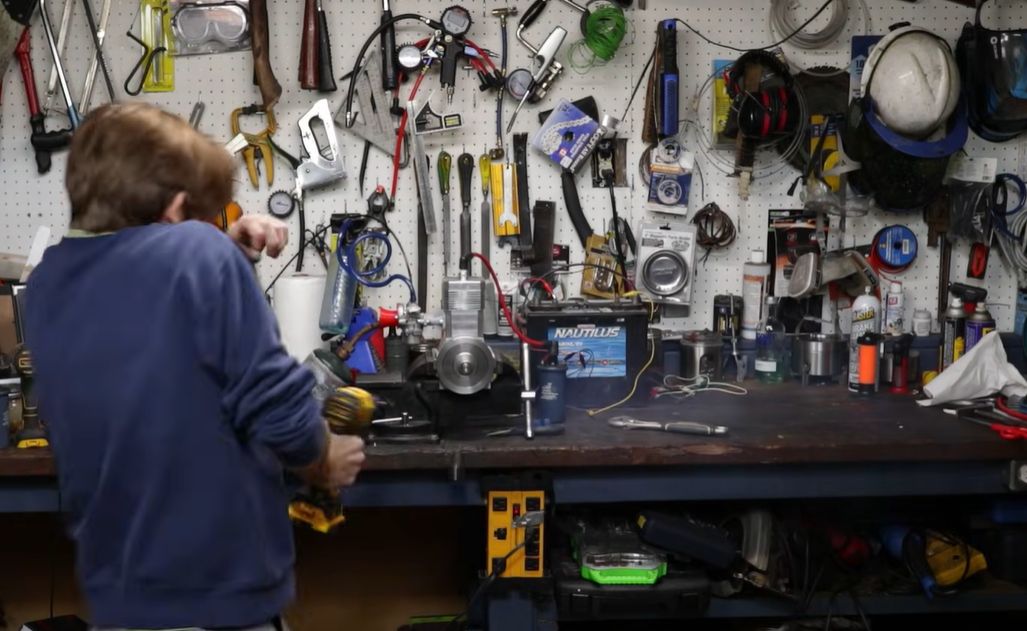
Bowen used only a basic mill and lathe to create the engine, a setup that he admits pushed the limits of safety. “The sketchiest part here is probably the use of only a basic mill and lathe, making the milling of certain shapes a definite OSHA violation,” he said, referring to the lack of proper guards and enclosures.
Project Details and Challenges
The single-cylinder engine was machined entirely from billet aluminum, a material chosen for its ease of machining and good heat dissipation. However, the process proved far from straightforward. Bowen encountered multiple expensive setbacks, including one major ruined part that taught him hard lessons about feed rates and tool paths.
“Fortunately I scraped by with just some expensive lessons learned and a major ruined part,” Bowen explained. “There are myriad ways to hurt yourself and/or others when you don’t follow proper procedures.”
Initial pressure testing showed a solid 150 PSI (10 bar) of compression, a figure that rivals many commercial small engines. With that encouraging sign, Bowen added a coil pack and contactor for spark ignition, then fueled the engine with the standard premixed gasoline-oil mixture.
Test Results and Performance
The engine ran mostly as expected, with no major mechanical failures. The only significant issue was a slight wobble in the flywheel, likely caused by a small manufacturing glitch during machining. Bowen noted that this wobble “should not cause too many issues” in the short term, but he plans to correct it in a future iteration.
Despite the successful run, Bowen emphasized that the project was not without risks. “Boringly, the engine mostly just runs and works as it should. This is of course not unexpected—much like how following the recipe for a pie produces said pie. But it does demonstrate how easy things are when you do not stray off the beaten path.”
Background
This is not Bowen’s first attempt at a two-stroke engine. His previous builds included a 3D-printed version and one constructed largely from hardware-store components. The billet aluminum version represents his most refined effort, combining the strength of machined metal with the simplicity of a single-cylinder two-stroke design.
Two-stroke engines are mechanically simpler than four-strokes, with fewer moving parts and readily available designs online. However, machining them from scratch requires significant skill and specialized equipment. Bowen’s choice to use a basic mill and lathe—tools common in small workshops—made the project accessible but also increased safety hazards.
What This Means
Bowen’s success demonstrates that a determined hobbyist can produce a working internal combustion engine using modest equipment. However, it also highlights the very real risks of such projects. Without proper safety measures—such as machine guards, dust collection, and fire extinguishers—DIY machining can lead to serious injury or property damage.
The project also underscores the importance of precision in manufacturing. Even a small manufacturing glitch, like the one that caused the flywheel wobble, can affect performance. For anyone inspired to try their own engine build, Bowen’s advice is clear: start with a proven design, invest in safety equipment, and expect to make costly mistakes.
As for what’s next, Bowen plans to refine the engine design and potentially scale it up to a twin-cylinder version. He also aims to document the full build process in more detail, offering a guide for other makers who want to follow in his footsteps—safely.