Introduction
Command-line tools are the backbone of many workflows, but their official documentation—the man page—often frustrates users rather than helps them. After contributing to the Git man pages and creating numerous cheat sheets for tools like tcpdump, git, and dig, I realized that the core documentation itself could be vastly improved. Instead of relying on external cheat sheets, why not embed that clarity directly into the man page? This article explores practical ideas to make man pages more navigable and user-friendly, inspired by real-world examples.
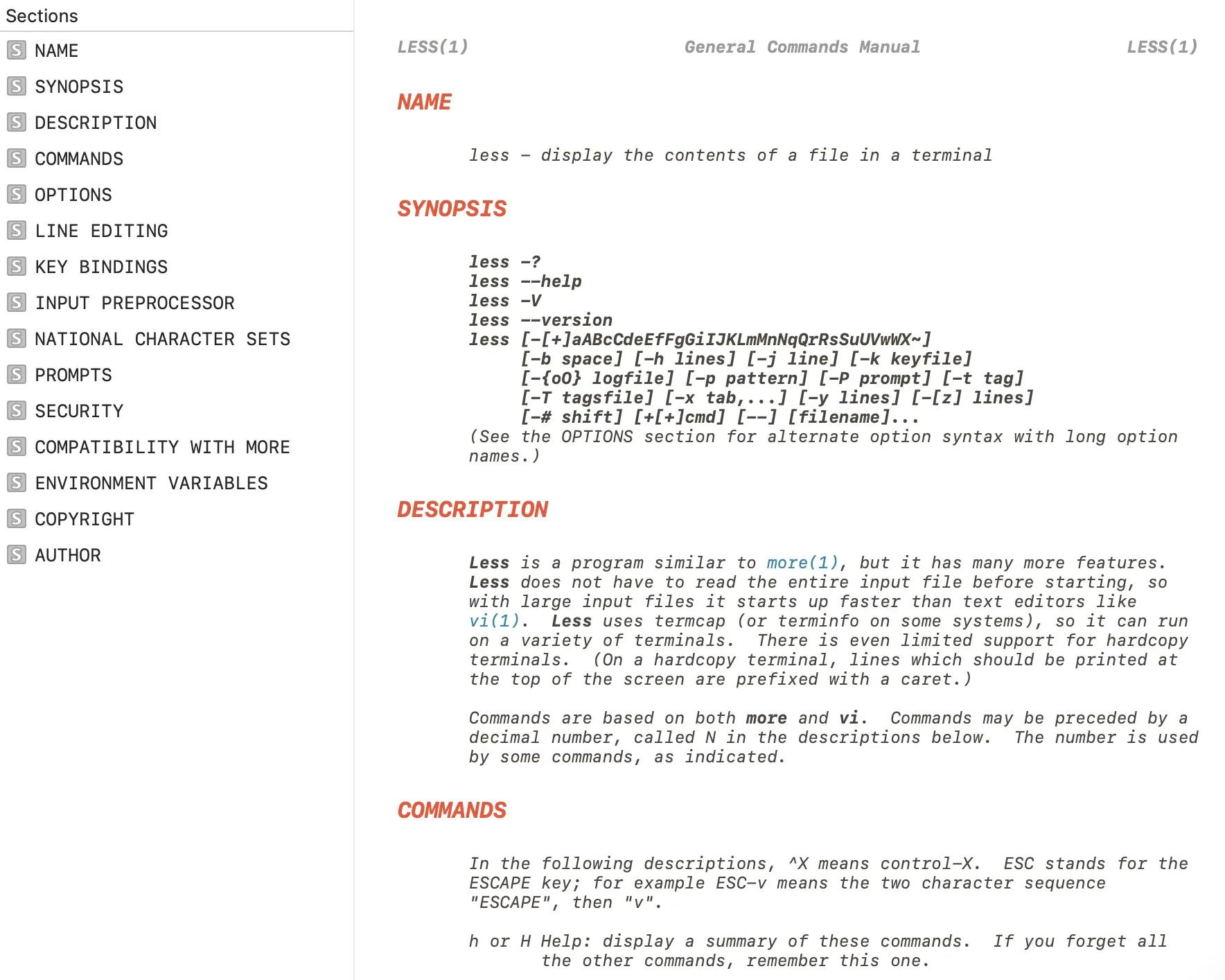
The Problem with Traditional Man Pages
Many man pages bury essential information under dense paragraphs, with options listed alphabetically in a long SYNOPSIS. For instance, the ls man page shows a laundry list of flags like [-@ABCFGHILOPRSTUWabcdefghiklmnopqrstuvwxy1%,]—a wall of letters that offers little context. Similarly, grep presents [-abcdDEFGHhIiJLlMmnOopqRSsUVvwXxZz], leaving users to guess which flag does what. The result is a steep learning curve and frequent reliance on external summaries.
Lessons from the Field: Examples of Better Man Page Design
To uncover what works, I asked the community for their favorite man pages. Several standout examples pointed toward three key improvements: an options summary, categorized options, and integrated cheat sheets.
The OPTIONS SUMMARY Approach (rsync)
The rsync man page offers a brilliant solution. Instead of a cluttered SYNOPSIS, it keeps that section minimal—just rsync [OPTION...] SRC... [DEST]. Then it adds a dedicated OPTIONS SUMMARY section with a one‑line description per flag:
--verbose, -v            increase verbosity
--info=FLAGS             fine-grained informational verbosity
--debug=FLAGS            fine-grained debug verbosity
--stderr=e|a|c           change stderr output mode (default: errors)
--quiet, -q              suppress non-error messages
--no-motd                suppress daemon-mode MOTD
This table‑like format gives users a quick overview without overwhelming detail. The full OPTIONS section later provides in‑depth explanations, but the summary serves as an immediate reference. This design bridges the gap between a cheat sheet and comprehensive documentation.
Categorizing Options for Easier Reference (strace)
The strace man page takes organization a step further by grouping options into logical categories: General, Startup, Tracing, Filtering, and Output Format. This categorization helps users quickly locate options related to a specific task, rather than scanning an alphabetical list. As an experiment, I tried reorganizing the grep man page into categories (e.g., “Search Control”, “Output Control”, “Performance”). One immediate benefit: the often‑forgotten -l option (which lists matching filenames) becomes easier to find when placed under “Output Control”. While the effectiveness of categories may vary, they reduce cognitive load and accelerate retrieval.
Embedding Cheat Sheets (Perl’s perlcheat)
The Perl documentation suite includes a dedicated man perlcheat page that presents syntax snippets in a compact, 80‑character‑wide format:
 SYNTAX
 foreach (LIST) { }     for (a;b;c) { }
 while   (e) { }        until (e)   { }
 if      (e) { } elsif (e) { } else { }
 unless  (e) { } elsif (e) { } else { }
 given   (e) { when (e) {} default { } }
This cheat sheet approach is highly effective for quick recall. It condenses the most common patterns into a single view, making it ideal for experienced users who just need a reminder. Incorporating such condensed references directly into a man page—either as a separate section or an appendix—could dramatically improve daily usability.
Implementing These Ideas
How can we apply these lessons to existing man pages? Start by adding an OPTIONS SUMMARY section for every tool that has more than a handful of flags. Keep the synopsis minimal and move quick descriptions into a table. Next, consider grouping options by category when the functionality naturally divides (e.g., input, output, filtering). Finally, explore embedding a cheat sheet subsection for the most common operations. Tools like groff and mandoc support tables and macros that can render these layouts beautifully.
Conclusion
Man pages don’t have to be intimidating. By borrowing design patterns from rsync, strace, and perlcheat, we can transform them into documentation that serves both beginners and power users equally well. A clear options summary, logical categorization, and embedded cheat sheets reduce the need for third‑party references and let users stay focused on their tasks. While these ideas are still early in my thinking, the positive feedback from the community suggests they’re worth pursuing. The next time you write or maintain a man page, consider giving it the cheat‑sheet treatment—your future self (and every user) will thank you.